Clew, a thread through anything you’re learning
Clew is an open-source study tool that turns a learning goal into a prerequisite graph. AI proposes the topics and connections; you review every change before it is saved. Planning happens from the graph, not from a chat history.
2026 · live at
clew.my · open source
here · Python · FastAPI · TypeScript · React · SQLite
What exists today.
21
days to build the first full version alone
40k
lines of Python, TypeScript, and CSS
300
topics generated and connected in one pass
97
unit tests covering planner, validation, quiz closure, MCP tools, repository ops
How it started
I wanted to learn machine learning alongside school. I loaded the school curriculum and the ML topic list into an LLM and asked for a dependency analysis: what do I actually need from the curriculum to reach a given ML target?
The answer was four topics, not three months. Most of what I was being told to learn was unrelated to the goal I cared about. The script that produced that answer became the project.
How Clew is different
Most knowledge tools help you store and organize more material. Clew starts with the goal and removes what you do not need, leaving the shortest useful learning path.
Obsidian / Roam
Organize knowledge
Linking + personal knowledge graph
Heptabase / Scrintal
Visual note-taking expansion
Spatial cards + canvases
Notion / Tana
Connected workspace
Structure + relational
Clew
Goal-directed minimum-path learning
Reduce curriculum to minimum viable path to a specific goal
What's in the repo
A single generation can propose up to 300 topics, connect their prerequisites, and return one graph. Before it becomes a learning path, the result must pass validation and user review.
Reviewed proposals
Generation → typed validation → snapshot → user review → apply. Invalid or disconnected changes are rejected with an explanation.
Typed proposal format
Every graph change follows a 231-line JSON schema with an operation ID, entity type, and rationale. Proposals stay readable and auditable.
Prerequisite checks
A topic is complete only when every prerequisite is complete. The quiz service verifies this by traversing the graph.
Read-only MCP tools
External clients can read graph state and progress through MCP. Changes still have to pass through the normal proposal and review flow.
Obsidian import and export
The importer reads explicit relation markers and shows a preview. The exporter writes Markdown with optional zones, artifacts, and progress.
Snapshot history
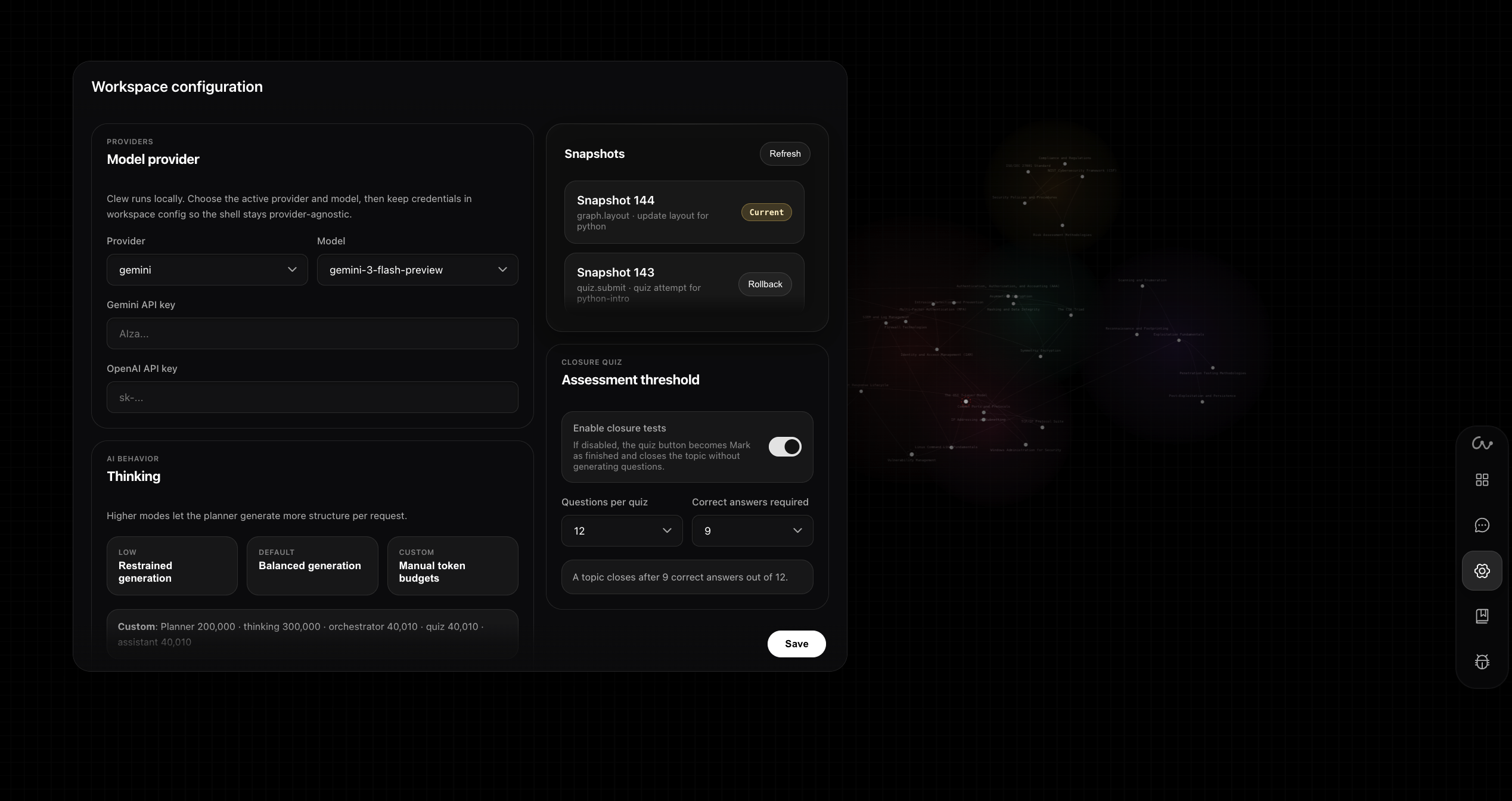
Every approved change creates an immutable snapshot. Rollback restores the previous graph from that history.
From the product
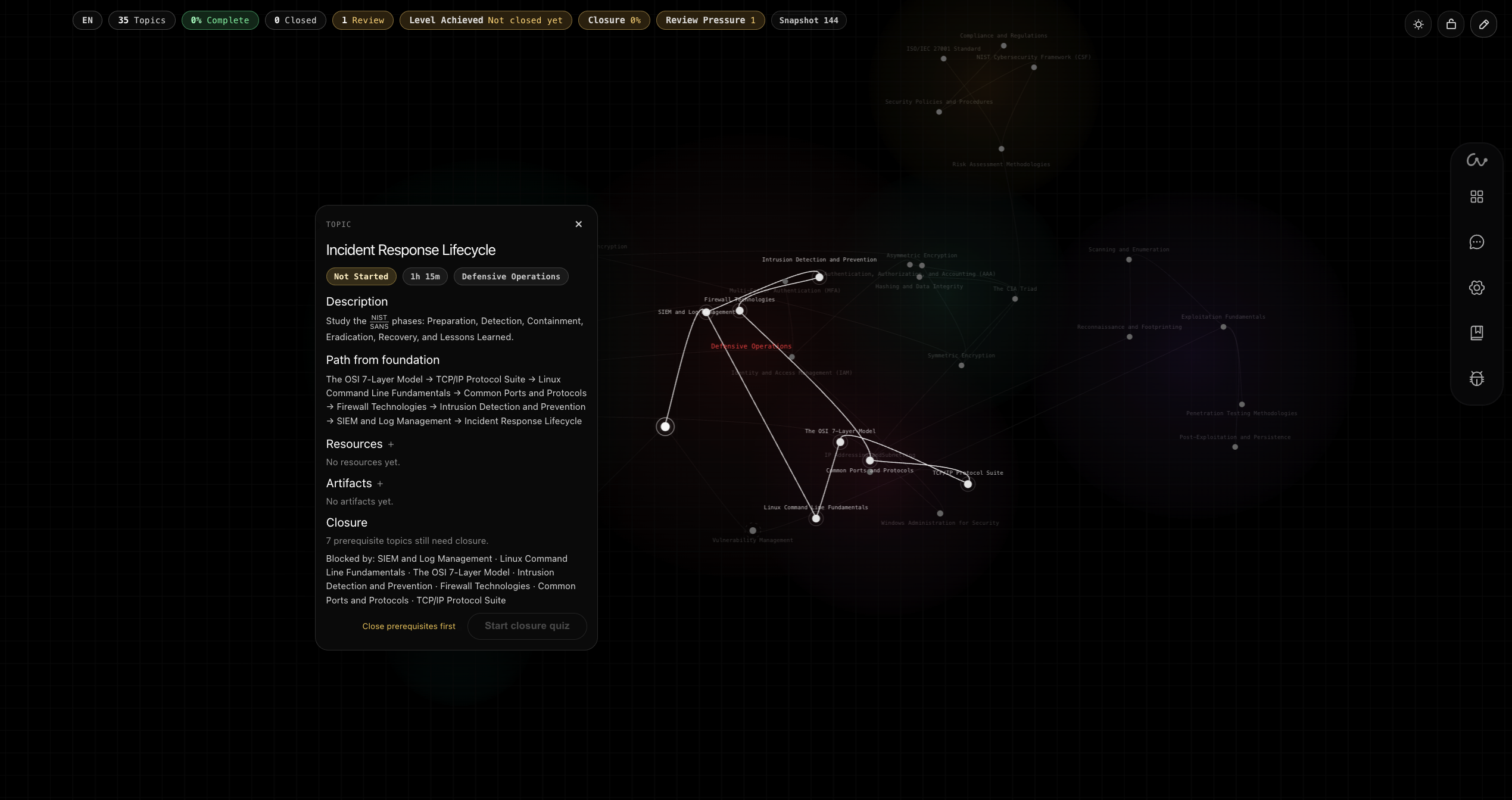
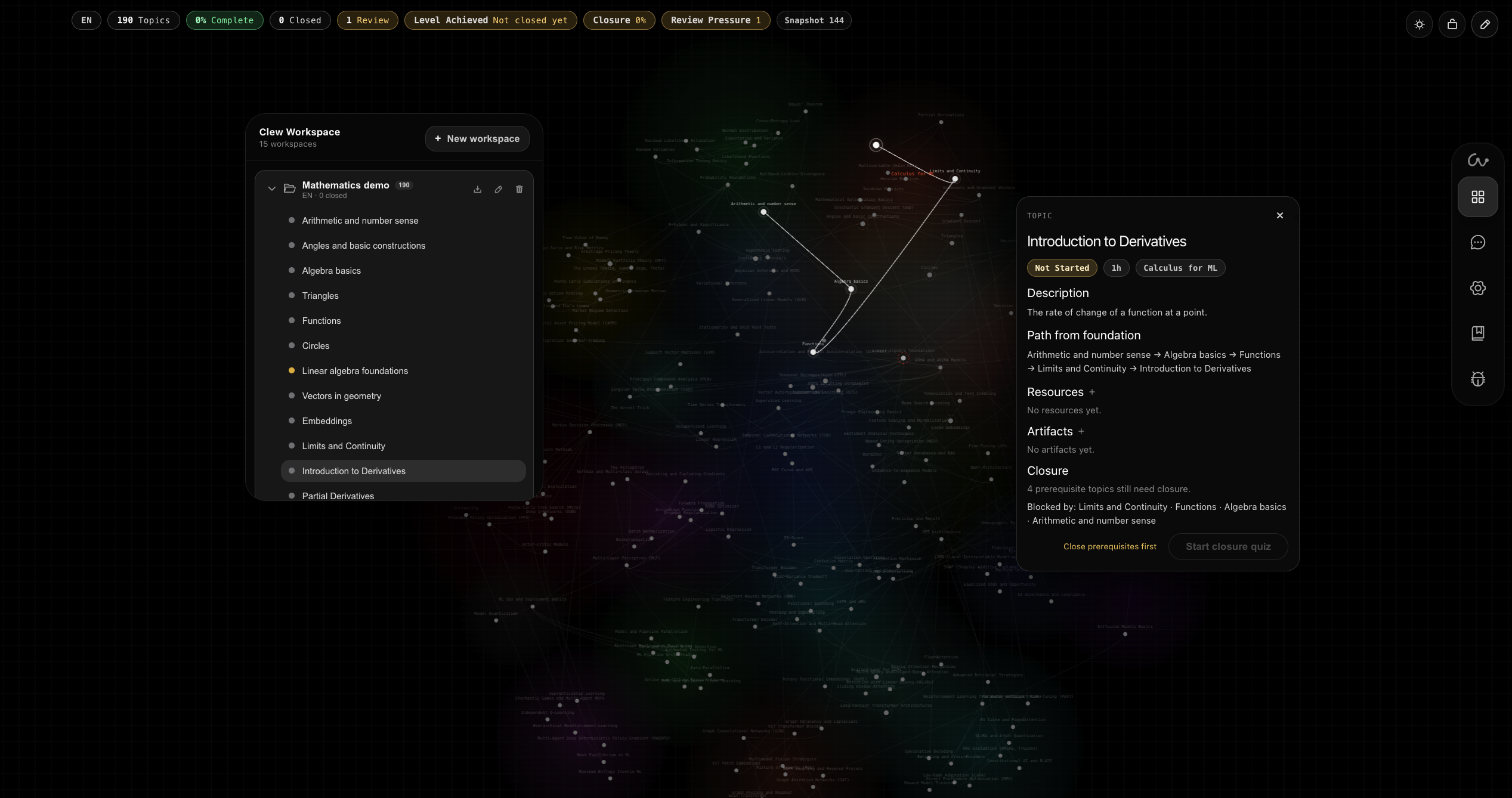
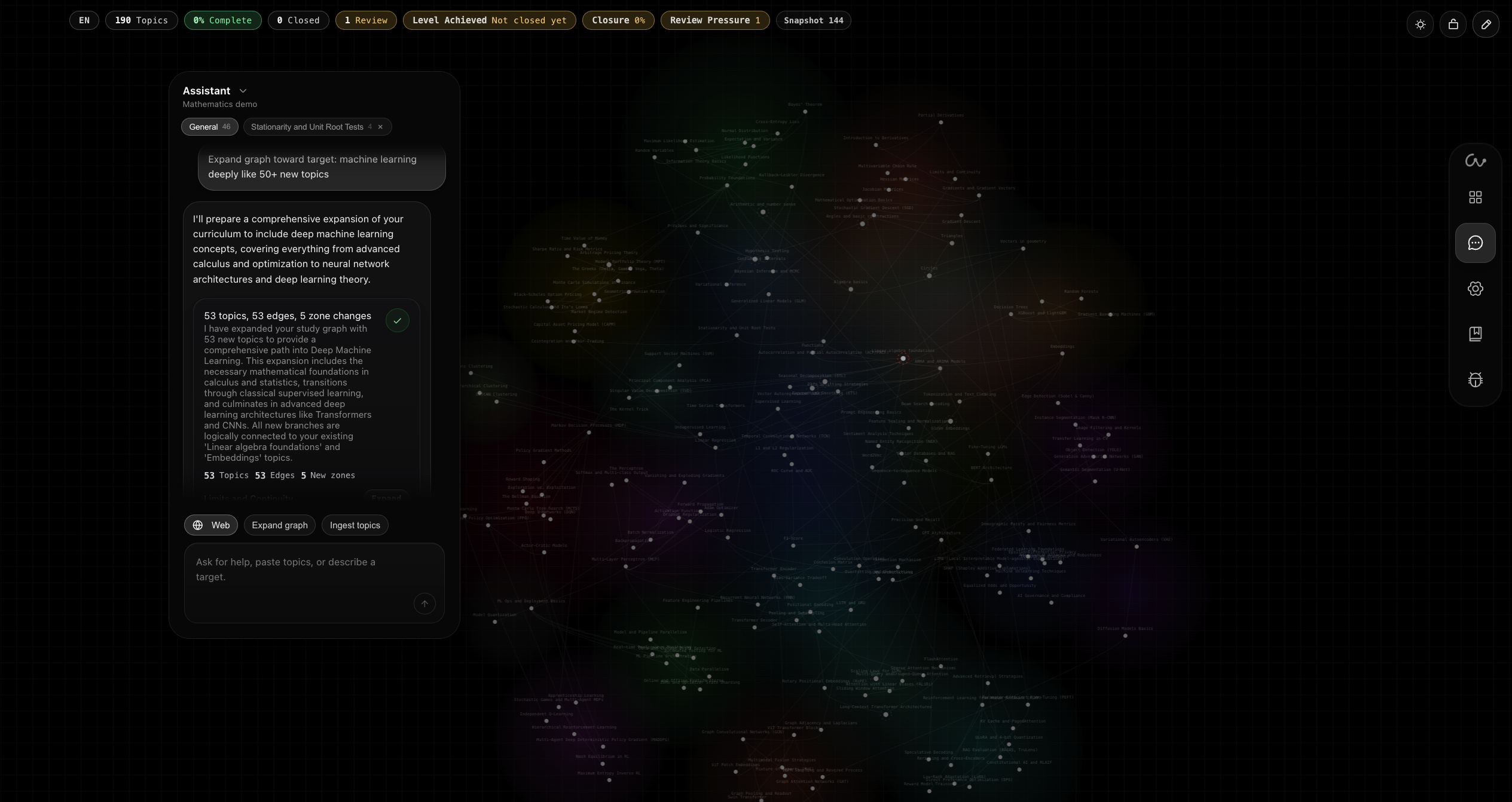
Screens from the live app: the graph, change review, and path navigation.
Built alone
I built Clew from the graph model and AI planner to the frontend, backend, MCP integration, and hosted release.
AI engineer
The planner takes a learning goal and the current graph and can return a connected graph of up to 300 topics in one pass. Validation and review keep large results understandable.
System builder
The frontend, backend, local and hosted versions, MCP, and Obsidian integration all use the same graph model. The app supports two model providers and user-owned API keys.
Founder
I built Clew to solve my own learning problem, then released it under MIT. The code is public and the hosted version is live at clew.my.
Open source under MIT. The code is on
GitHub, and the hosted version is at
clew.my.