Game operations ecosystem · Software and operations for a project with an audience of millions.
↓ SCROLL FOR DETAIL
Game operations ecosystem
I design and maintain the software and operations platform behind an unofficial multiplayer shooter. Over three years, my work grew from small contributions into leading its engineering and product operations.
The platform connects analytics, moderation, support, traffic, partnerships, incident response, administrative tools, and internal team workflows across more than 10 production services.
2023–present · lead engineer and product operator · standleo.com ↗ · main channel ↗ · Python · Node.js · TypeScript · Next.js · Postgres · MySQL · Mongo · Telegram
Scale of the project I work on.
9M
unique accounts created over three years
0.8M
monthly active audience
440k+
subscribers on the main channel
80
admin operators using the internal platform
110k+
members in the main public chat
3,000
average concurrent players online
30k
report cases reviewed in 3 months
10+
separate services inside the ecosystem
What it is
The ecosystem is the set of tools the team uses to run the project. It brings player activity, incidents, moderation, support, and current work into one operational view. The development and admin teams use the same data and workflows.
Before I built it, metrics were spread across chats and incomplete dashboards, purchase fulfillment was split across several services, and moderation depended on manual coordination. Now those parts are connected and the team can see who is responsible for each piece of work.
The game is an unofficial, fan-made project run by a small team. This case study focuses on my role in that team, one of its key technical and operational roles: infrastructure, backend systems, automation, and the software around the project rather than the game client itself.
References to the game are provided only as operational context. I am not the owner of the game or game client, and I do not claim ownership of its assets or underlying intellectual property.
Architecture
The repository is shown as a tree. Select a branch to see what it does, its stack, and its size. Classic and Lite are separate versions of the game with their own audiences.
* Architecture snapshot as of August 10, 2026. This tree covers the ecosystem repository and is updated as its services change.
ecosystem/138,382 LOC total
core_agent/55,448 LOC
main/32,950 LOC
apps/portal/11,181 LOC
apps/donate_bot/9,636 LOC
apps/promo_donate_bot/5,157 LOC
apps/promo_code_bot/5,244 LOC
apps/shared/1,346 LOC
administration/34,843 LOC
apps/support_bot/4,215 LOC
apps/ban_bot/1,335 LOC
apps/beta_access_service/3,011 LOC
apps/chat_moderation_bot/3,713 LOC
apps/partnership_bot/20,554 LOC
apps/anti_cheat_service/656 LOC
classic/11,089 LOC
lite/3,649 LOC
infrastructure/403 LOC
docs/5 docs
core_agent/
Operations AI agent
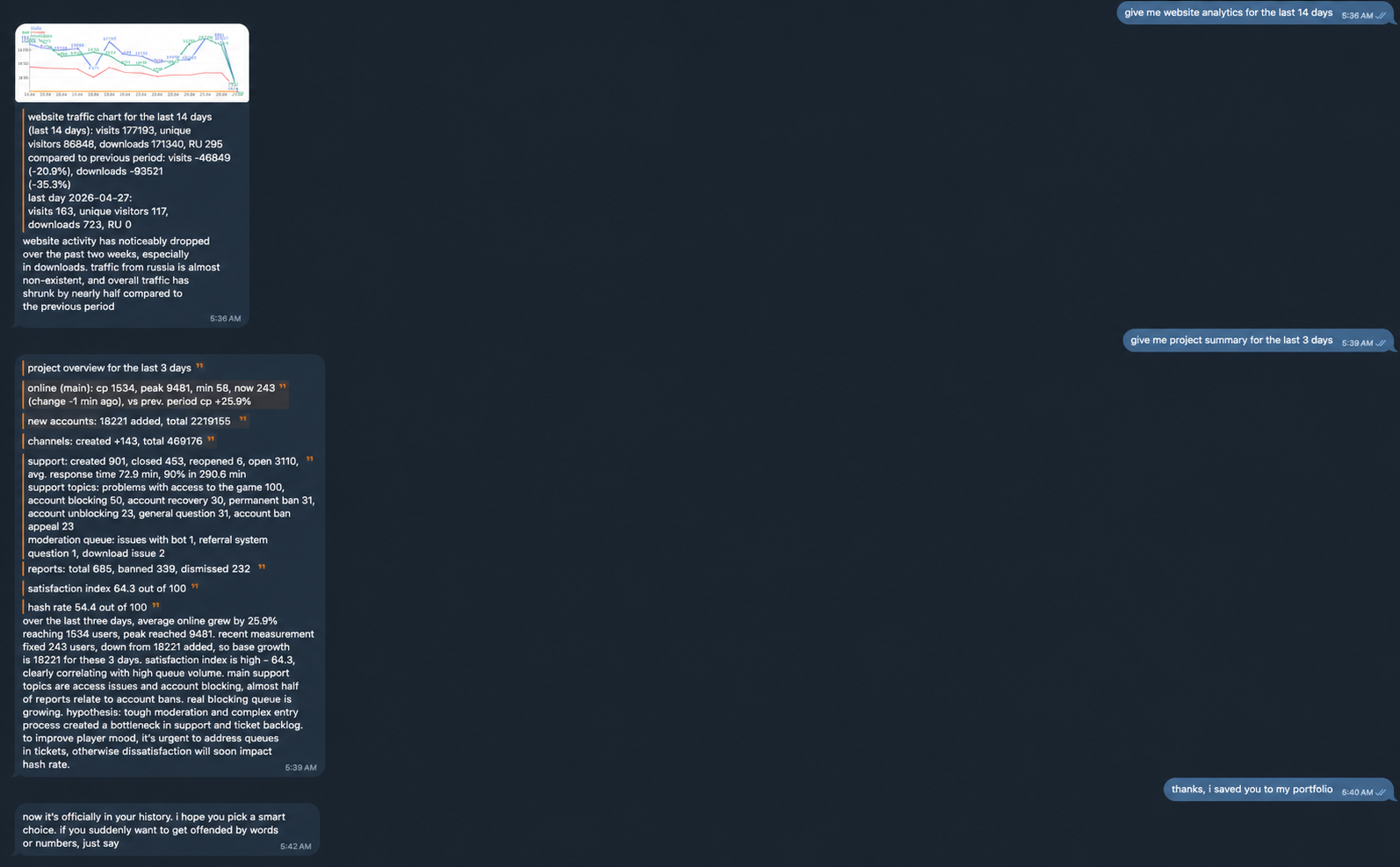
Reads live project data, answers admin questions in plain language, and generates charts and reports. It remembers follow-up context, audits three chat categories, and calculates audience sentiment signals. The model interprets requests; deterministic tools read data and perform actions.
I lead engineering and product operations around the project: infrastructure, backend systems, development coordination, incidents, analytics, and community operations. I designed and built the software that connects those areas.
What it handles in practice
01
After an attack wiped a database containing 7M player records, I played a key role in restoring the live state within one week. Players saw no downtime, and moderation and fulfillment continued to run during the recovery.
02
One admin can generate up to 200 analytical summaries per month by asking questions in plain language. The agent keeps the context between follow-up questions.
03
Purchase flows from several providers share one state and fulfillment model, giving the team a consistent history instead of disconnected service records.
04
The main chat processes about 5,000 messages per day. Volunteers reviewed 30k cheater reports in three months, and the results are collected as operating data I can follow across cases and over time.
The work in practice
My role spans engineering leadership, product operations, the operations agent, and the production systems around the project.
AI engineer
The operations agent serves 80 admins. It answers questions with deterministic tools and SQL, remembers follow-ups, audits three chat categories, and produces audience and moderation reports. Failed requests stop with an explicit error.
Lead engineer
I lead the technical direction across infrastructure, backend systems, automation, incident response, and development coordination while continuing to build directly.
Product operator
I connect engineering work with moderation, support, partnerships, analytics, and the daily decisions needed to keep a large live project operating.
Fullstack
I built the core Python and Node.js services, the Mongo, MySQL, and Postgres data layer, fulfillment, admin tools, analytics, and the public Next.js site. The ecosystem spans more than 10 separate production services.
Private production evidence is available on request.
For serious hiring or partnership discussions, write to [email protected]. I can walk through the system, show selected parts of the source code, and provide a live walkthrough of relevant analytics or selected database records supporting the figures on this page without exposing raw user data.